Dog Food Calculator: how much should your dog actually eat?
The bag chart guesses. This calculator doesn't. Enter your dog's weight, life stage and the food you really feed — get the exact daily portion in calories, grams and cups, from the formula published by the AAHA and the Pet Nutrition Alliance.
Enter your dog's details
Results update as you type. Use ideal weight if your dog needs to lose weight.
Every feeding question, one exact tool
Fourteen specialised calculators sharing one verified engine — raw, puppy, weight loss, mixing, cost, brands and more.
Dog Food Calculator by Weight
Portions for every weight, 1 kg to 90 kg — table first, calculator second.
Dog Calorie Calculator
RER & MER explained and calculated — resting vs daily energy, per life stage.
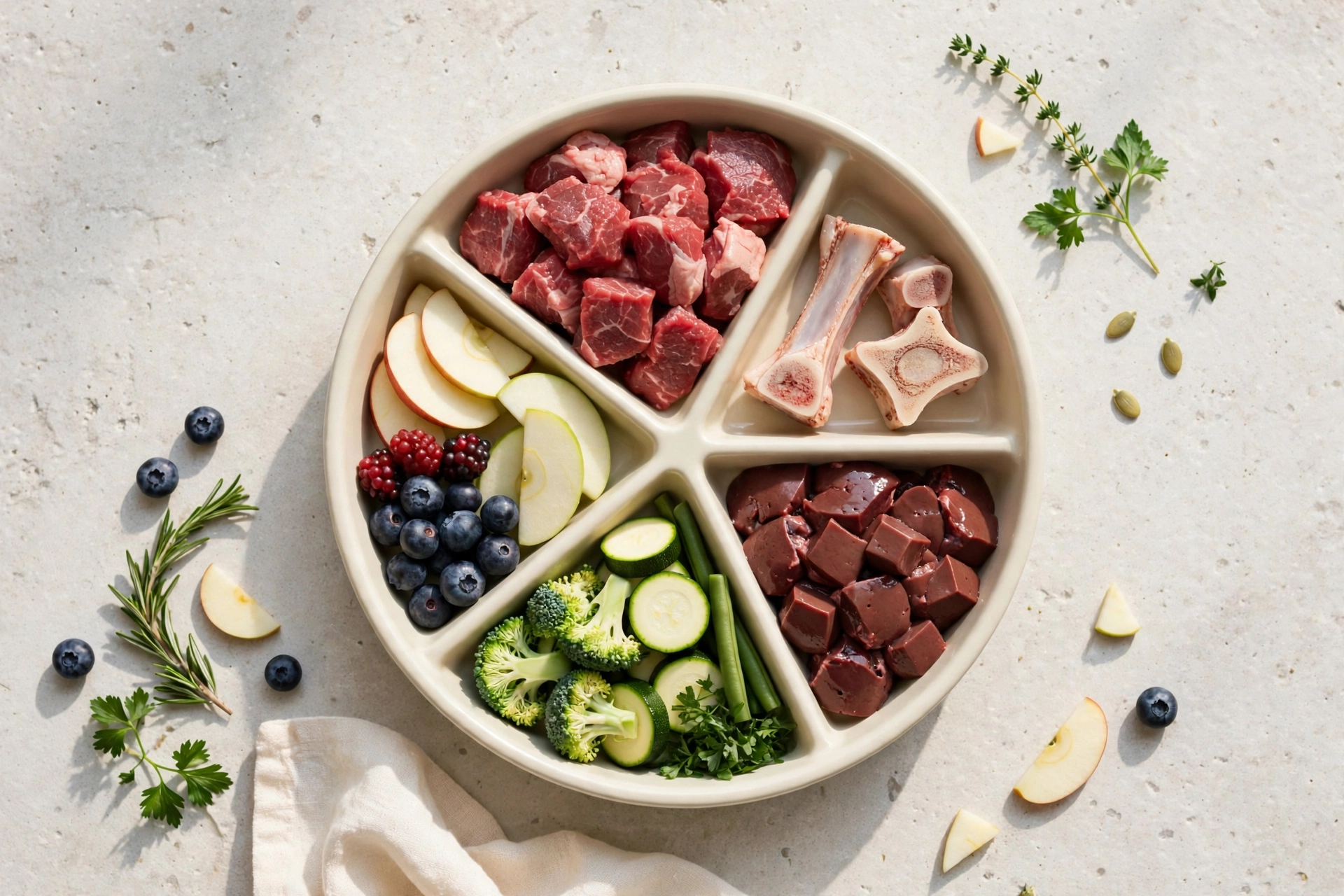
Raw & BARF Calculator
Daily raw grams split 70/10/5/5/10 — meat, bone, liver, organ, veg.
Dog Weight Loss Calculator
Safe deficit portions at target-weight RER, with a realistic timeline.
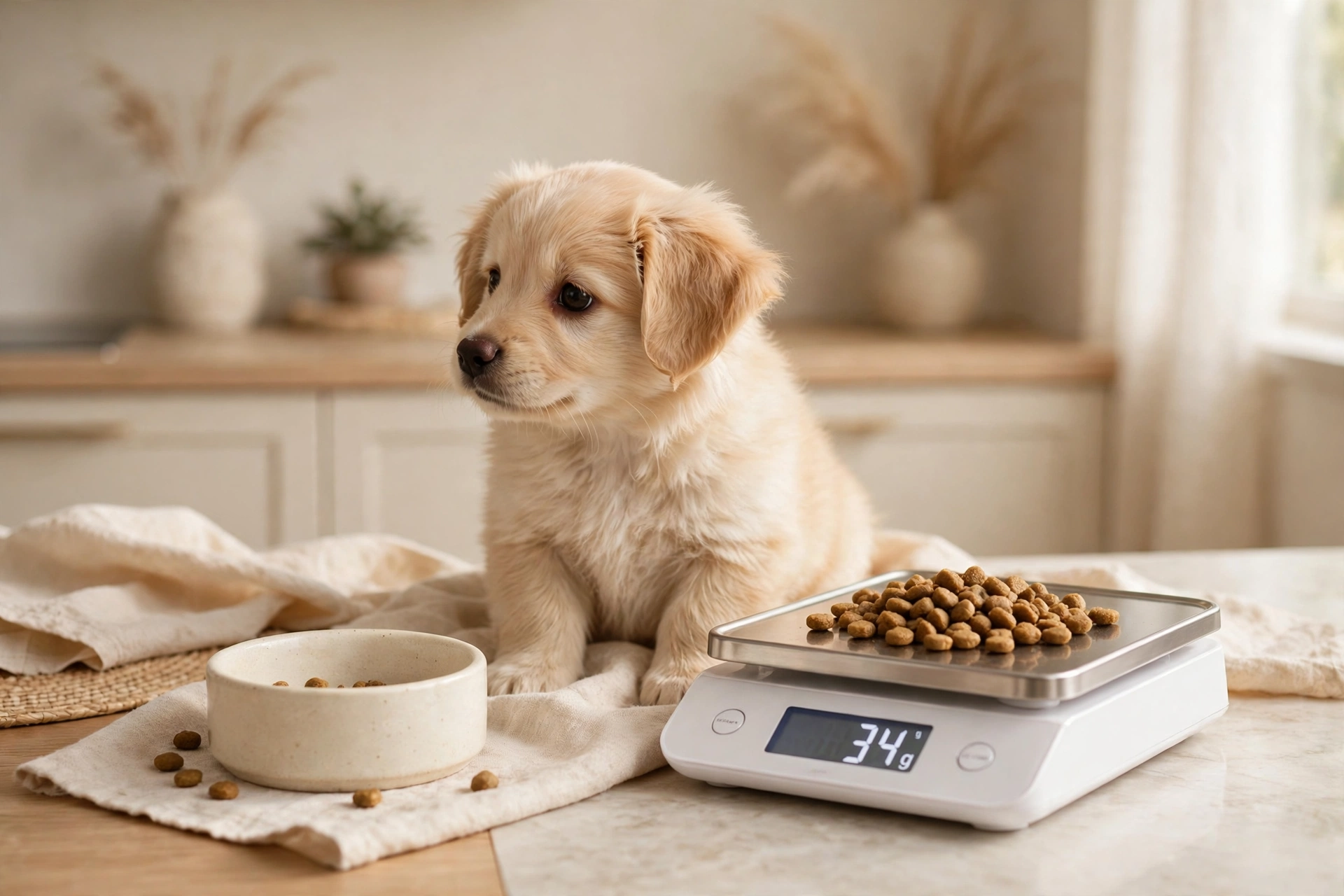
Puppy Food Calculator
Growth portions by age — weighed in grams, not guessed in cups.
Homemade Dog Food Calculator
Cooked rations by calories — with the nutrient-balance warnings that matter.
Wet & Dry Mix Calculator
Feeding both? Split calories any ratio — grams of each, exactly.
Dog Food Cost Calculator
Cost per day and month, and how long a bag really lasts.
Cups ↔ Grams Converter
Portion conversion by kibble density — why one cup is never one cup.
Dog Nutrition Calculator
Protein and fat grams per day, checked against AAFCO minimums.
Dog Food Portion Calculator
Meals split exactly — per-meal grams for 1 to 4 feedings a day.
Fresh Dog Food Calculator
Fresh and gently-cooked portions by real fresh-food energy density.
80/10/10 Raw Calculator
The strict prey-model split: 80% meat, 10% bone, 5% liver, 5% organ.
Homemade Recipe Calculator
Scale a home recipe to your dog's exact daily calories.
Breeds A–Z
59 breed pages with portions worked out for each breed's real weight range.
How We Calculate
The full method: formulas, factors, sources, and the ±50% rule that keeps every number honest.
Daily portions by weight
Anchor weights for a neutered adult on typical kibble (370 kcal/100 g), 10% treat allowance removed. Generated by the calculator's own engine — not typed by hand.
| Dog weight | RER (resting) | Daily target | Food per day | Per meal (×2) |
|---|---|---|---|---|
| 5 kg · 11 lb | 234 kcal | 374 kcal | 91 g | 46 g |
| 10 kg · 22 lb | 394 kcal | 630 kcal | 153 g | 77 g |
| 20 kg · 44 lb | 662 kcal | 1,059 kcal | 258 g | 129 g |
| 30 kg · 66 lb | 897 kcal | 1,436 kcal | 349 g | 175 g |
| 50 kg · 110 lb | 1,316 kcal | 2,106 kcal | 512 g | 256 g |
Neutered adult (×1.6), food at 370 kcal/100 g, 10% treat allowance removed, 2 meals. Generated by the same engine as the calculator above.
How the number is built
No black box. Every figure on this site can be checked by hand.
Resting energy (RER)
What a dog burns doing nothing at all. It scales with metabolic weight, which is why a dog twice as heavy does not need twice the food.
RER = 70 × (kg)0.75Life-stage factor (MER)
Multiply by the matching factor: 1.6 neutered adult, 1.8 intact, 1.0 weight loss at ideal weight, 3.0 puppy under 4 months.
MER = RER × factorCalories → your food
Remove the treat budget (max 10%), divide by your food's real label energy. Same dog, different bag, different grams.
Grams = kcal ÷ (kcal/100g ÷ 100)Why brand tools can't give you this answer
Every manufacturer's calculator has the same conflict of interest: it only knows its own food, and its business is selling more of it. The big pet retailers' "calculators" are product selectors wearing a calculator's clothes.
This one is brand-neutral. Bring any bag — the math is identical, the kcal come from your label, and the portion is the portion.
Or compare the two methods head to head: calculator vs bag chart →
What makes the number trustworthy
- Formula published by AAHA, the Pet Nutrition Alliance, Merck and WSAVA — unanimous across all four
- Every table is generated by the same engine as the calculators — no hand-typed charts to drift out of sync
- The ±50% individual variance is stated on every result, not buried in small print
- Weight-loss math uses ideal body weight, the way clinics actually prescribe it
Is your dog the right weight? Check the body condition score
The portion is only half the answer — the dog in front of you is the other half. Vets score body condition on a 9-point scale; the healthy target is 4–5.
Feel the ribs
Ribs should be easy to feel under a thin fat cover — not visible, not buried. If you have to press hard to find them, the portion is too big.
See the waist
Looked at from above, there should be a waist behind the ribs. No waist from above means the dog is carrying too much fat, whatever the chart says.
Check the tuck
From the side, the belly should tuck up behind the ribs. A straight or sagging line means the portion needs to come down by about 10%.
Score 6 or above? Feed for the target weight with the weight loss calculator and re-score every two weeks. Score 3 or below? Feed up by 10% and check again in two weeks — and see a vet if a thin dog keeps losing.
How to use this calculator
Enter weight
Enter the dog's weight (use ideal weight for weight loss).
Select life stage and goal
Select the life stage and goal so the correct MER factor applies.
Enter food energy density
Enter the food's energy density (kcal per 100 g) from its label.
Read the daily portion
Read the daily portion in grams, split it across meals, and adjust by 10% every 2 weeks based on body condition.
Feeding questions, answered straight
How much food should a 20 kg dog eat per day?
A neutered adult 20 kg dog needs about 1,059 kcal/day (RER 662 × 1.6). On typical kibble at 370 kcal/100 g, with a 10% treat budget removed, that is roughly 258 g per day — about 129 g per meal over 2 meals.
Why does the bag chart give a different amount?
Bag charts assume an average intact, active dog and round up to whole cups. Cups are volume; foods differ by 100+ kcal per cup. Feeding by the chart is the most common cause of slow weight gain in pet dogs.
Should I weigh food or use cups?
Weigh it. A gram scale is exact; cups swing up to 40% with kibble size and scooping. Most owners who switch discover they were overfeeding by 15–40%.
How much should a puppy eat?
Puppies use higher factors: 3.0 × RER under 4 months, tapering smoothly down to 2.0 × RER by 8 months, over 3–4 meals when young. The puppy calculator handles current and expected adult weight.
Is this a substitute for my vet?
No — it is a starting portion from the same published formulas clinics use. Diabetic, kidney, pancreatitis, pregnant or nursing dogs need a vet-set plan.
How much should a senior dog eat?
Seniors usually eat less: the senior factor is 1.4 × RER instead of 1.6, so a 20 kg senior needs about 927 kcal/day instead of 1,059 — roughly 225 g of typical kibble. But judge by muscle and condition, not birthdays: a still-active older dog may hold condition on the adult number. Watch muscle loss — seniors need protein, not just fewer calories.
How do I switch my dog to a new food?
Over 7 days: 25% new food for 2 days, 50% for 2 days, 75% for 2 days, then 100% — keeping the total daily grams at the calculator's number throughout. If stools loosen, hold at the current mix for an extra day or two. Sensitive stomachs may need 10–14 days instead of 7.
How much should I feed an overweight dog?
Feed for the weight your dog should be, not the weight they are: calories equal 1.0 × RER of the target weight. A dog targeting 20 kg gets 662 kcal/day — about 195 g/day of a 340 kcal/100 g weight-control food. Aim for 1–2% loss per week, weigh every two weeks, and check the body condition score below.